 |
|
| |
|
 |
|
. |
|
||||||||||||||
copyright
©1999-2000 |
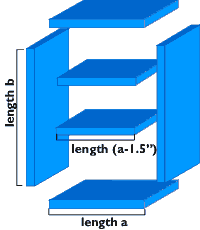 1.
You’ll be cutting your pine board into two pieces of length a, and two
of length b, plus however many shelves of (a-1.5") length that you’d
like. (Yes, that measurement for the shelves is indeed "-1.5",
not 2", due to the fact that the thickness of your 1"x10"
or 1"x12" will actually be ¾", not 1". ) Measure
carefully before cutting, and mark with a line. 1.
You’ll be cutting your pine board into two pieces of length a, and two
of length b, plus however many shelves of (a-1.5") length that you’d
like. (Yes, that measurement for the shelves is indeed "-1.5",
not 2", due to the fact that the thickness of your 1"x10"
or 1"x12" will actually be ¾", not 1". ) Measure
carefully before cutting, and mark with a line.
2. Use
c-clamps to clamp the board to a pair of sawhorses, or on a sturdy
table/workbench, in such a way that the cut line hangs just off the edge
of whatever you’re using as a support. You’ll want to insert a piece
of wood between the c-clamp and your board, to avoid putting a big dent 3.
Sand the rough cut edges using the sandpaper.
6. Use a drill bit that’s smaller in diameter than your wood screws to first drill holes where the screws will go. This will help to prevent the wood from splitting when it comes time to put in the screws. Once you’ve drilled those holes, the screws are ready to go in. If your drill has an electric screwdriver attachment, by all means use it; otherwise, a good old-fashioned manual screwdriver will do just fine. 7. Take a look at your book collection and determine whether you’ll need tall shelves, medium shelves, short shelves, or a combination thereof. Bear in mind that it’s a good idea to put the tall heavy books on the bottom, where there’ll be no danger of shelf warp-age. ---------------------------> lounge . nourish . host . laze . home. |
||||||||||||||||





 in your nice wood. Using the handsaw, saw the pine board with long, even
strokes, following the cut lines as carefully as possible.
in your nice wood. Using the handsaw, saw the pine board with long, even
strokes, following the cut lines as carefully as possible.
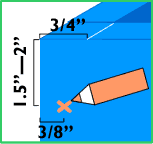 5. You’re
now ready to screw the boards together. Mark a dot in each corner of the
top and bottom pieces of wood as
shown (left).
5. You’re
now ready to screw the boards together. Mark a dot in each corner of the
top and bottom pieces of wood as
shown (left).